
AML Transaction Monitoring
Reduce false positives and strengthen your compliance process.

Where over 800+ firms redefine transaction security and compliance.












Be Aware of Suspicious Transactions
Sanction Scanner monitors transactions your customer make in real-time to detect suspicious transactions. The software stops the transactions and records the transaction for investigation if it detects a suspicious transaction. You can easily integrate Sanction Scanner into your project with API.
Set Rules and Create Scenarios
You can set rules and create scenarios with the rule-writing feature. It'll help you reduce false positive alarms, focus on correct warnings, and reduce your workload.

96.99%
Reduced False Positives

80%
Reduce Own Control Workload

100%
AML Regulations Compliance
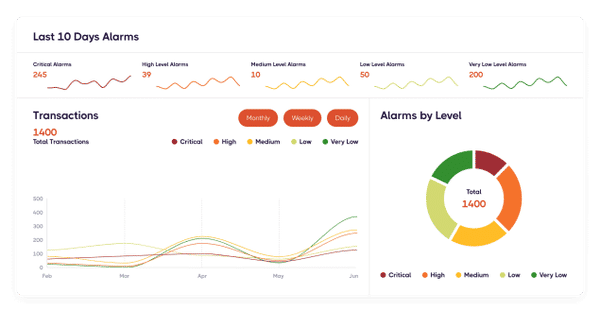
Quickly Respond to Suspicious Transactions with Real-Time Alarms
Don't wait until the end of the day to see alarms. You can see suspicious alarms depending on your scenarios and rules and see alarms by their risk levels(1-5).
Features

Powerful Case Management

Full Audit
Trails

User-Friendly
Dashboard

Live Transaction
Screen

Integrated Sanction
and PEP Query
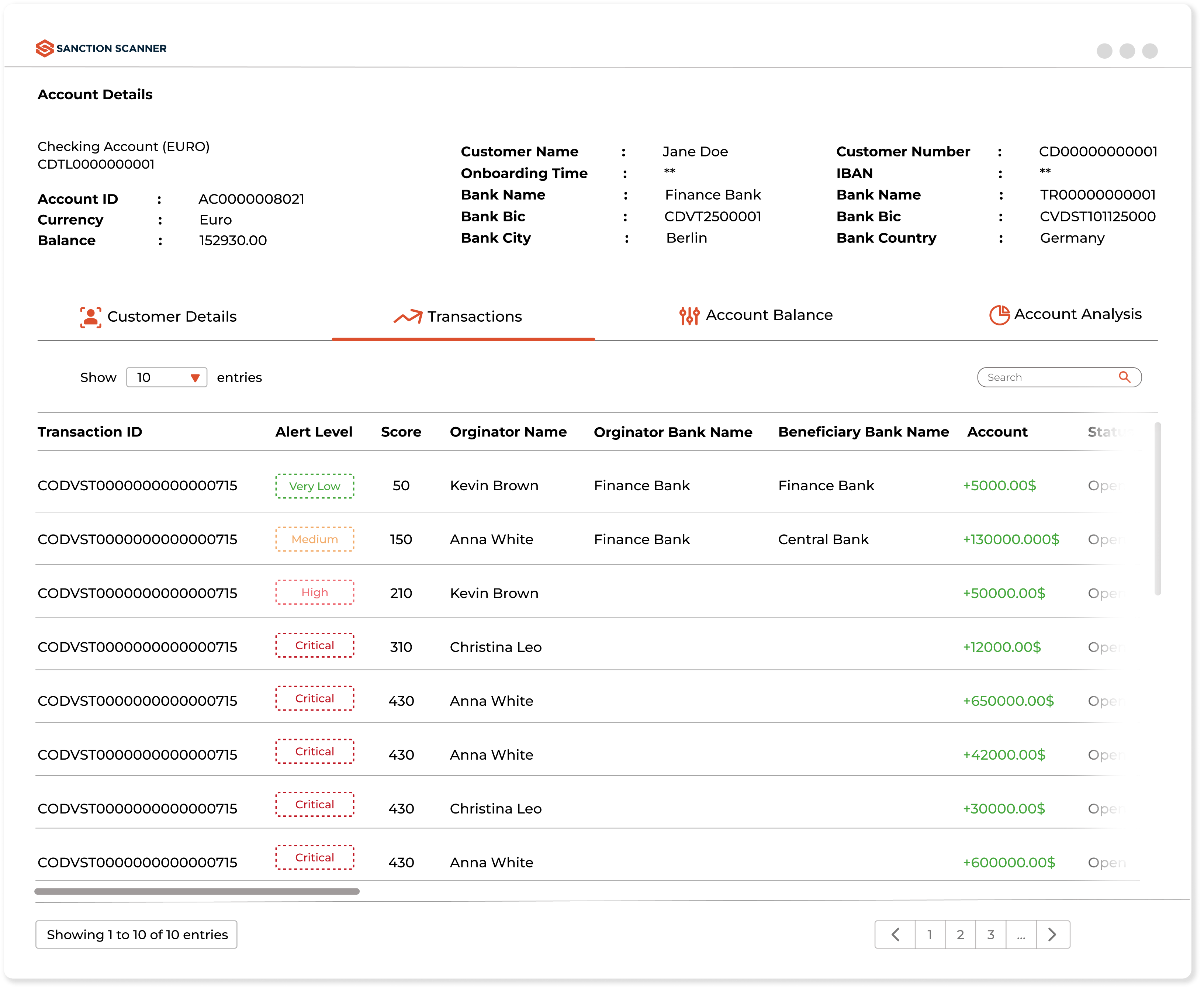
Fast & Smooth Integration with Ready to Use Rules
You can use our ready-to-use rule sets compatible with each sector. You can also create different rule sets specific to your customer group.
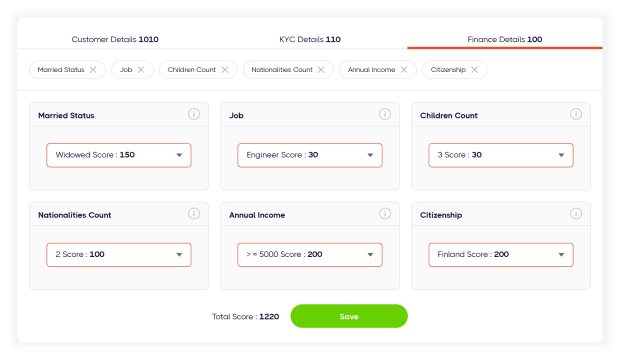
Test your Rules with Advanced Sandbox Test Environment
You can determine your customers' risk scores according to their job, age, income, etc. And you can define alarms (low, medium, high, critical) based on your customers' risk levels. You can also set Transaction Rules depending on your customers' risk scores.
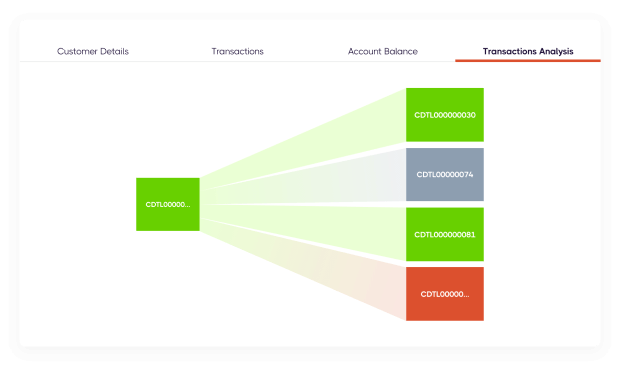
Peer Group Analysis
You can analyze the accounts trade with each other using the Transaction Analysis feature and view the Account Name, Volume, Balances, and relation of each account.




Dynamic Customer Risk Assessment and Scorecard
You can determine some criteria according to your customers' job, age, income, etc., and assign risk scores accordingly to these criteria. You can define alarms such as low, medium, high, critical accordingly to those scores or you can write Transaction Rules that depend on these Customer risks scores.

What our customers say

“Sanction Scanner has made a real difference for us. We went from checking customers one by one to a single platform that screens more than 3,000 of them around the clock, so our analysts can finally focus on real risk. I'd recommend it to any insurer without hesitation.”
“With Sanction Scanner, we offer a fast, easy, and secure customer onboarding process. Thanks to its enhanced scanning tool, we focus on real risks, not false positives. Thus, we can meet our AML obligations and our customers’ expectations.”
“Sanction Scanner helps our Group navigate the complex network of sanctions. It is a significant support for legal compliance, helping us prevent potential legal, financial and reputational damages.”

“Sanction Scanner has made a real difference for us. It transformed our daily work. We moved from screening customers one by one to a unified platform where our analysts can focus on what actually matters. I would strongly recommend finding the right partner early.”




AML Transaction Monitoring
Transaction monitoring is the ongoing review of customer transactions to detect unusual or suspicious activity that may indicate money laundering or fraud. It analyzes patterns, amounts, and frequency against risk rules and customer profiles, generating alerts for compliance teams to investigate and report where necessary.
Transaction monitoring is important because it detects suspicious financial activity that static onboarding checks cannot catch. It allows businesses to identify money laundering, terrorist financing, and fraud in real time, meet regulatory reporting obligations, and file suspicious activity reports based on evidence from actual transaction behavior.
Transaction monitoring works by applying rules and risk scenarios to customer transactions as they occur. The system compares each transaction against thresholds, behavioral baselines, and known typologies, then generates alerts when activity looks suspicious. Compliance analysts review these alerts and escalate or report cases as needed.
Common red flags include structuring, rapid or repeat transfers, large round-number transactions, and transfers to high-risk jurisdictions.
Sanction Scanner's analytics engine continuously monitors these patterns and generates instant alerts for further investigation.
Name screening mainly screens individuals and organizations against sanctions and watchlists during onboarding, while transaction monitoring actively watches customer activity on an ongoing basis for suspicious activity.
Together, these solutions form an end-to-end AML solution that delivers both initial and ongoing compliance.
FATF guidelines require institutions to perform risk-based monitoring, report Suspicious Activity Reports (SAR), and implement effective controls to identify unusual transactions.
Sanction Scanner helps organizations meet these global standards with customizable risk scoring, alert management, and automated reporting workflows.
Yes. Risk-based monitoring allows multiple customer segments to be monitored according to different thresholds and rules.
Sanction Scanner enables you to set up risk categories, scoring models, and frequency tiers that mirror your internal compliance policies.
AI identifies hidden relationships and aberrant behavioral patterns that may not be picked up by static rule-based systems.
Sanction Scanner's AI engine learns from feedback continuously to reduce false positives by up to 97%, leading to more accurate alerts and less manual review time.
Failing to monitor transactions properly can lead to severe regulatory fines, loss of licenses, and significant reputational damage.
For example, Deutsche Bank was fined $186M for inadequate AML monitoring controls. Sanction Scanner helps businesses avoid such outcomes with automated, audit-ready solutions.
Absolutely. Sanction Scanner offers scalable, API-based solutions suitable for startups and SMEs—without the need for complex infrastructure.
Yes. Our system supports SWIFT MT and ISO 20022 formats, enabling real-time monitoring of international payments. We extract key fields from SWIFT messages (e.g., sender/receiver, amount, BIC, jurisdiction) to apply screening rules and flag suspicious activity across cross-border flows.
The purpose of transaction monitoring is to identify and report transactions that fall outside a customer's expected behavior. It supports AML compliance by detecting red flags such as structuring, rapid movement of funds, or high-risk counterparties, enabling timely investigation and regulatory reporting.
A false positive is an alert that flags legitimate activity as suspicious, creating unnecessary review work. A false negative is genuinely suspicious activity that the system fails to detect. False positives waste resources, while false negatives create real compliance and financial crime risk; effective AML systems aim to minimize both.
Monitoring tools generate alerts for unusual activity. Once reviewed, confirmed cases are escalated into Suspicious Activity Reports (SARs), enabling institutions to meet regulatory reporting obligations.
Yes. Crypto exchanges and VASPs are required to monitor transactions for layering, mixing, or rapid wallet movements—especially those involving privacy coins or high-risk jurisdictions.
Yes. Our platform includes a sandbox environment where compliance teams can test transaction monitoring rules using historical or simulated data. This allows fine-tuning of thresholds, reducing false positives and ensuring rules are well-calibrated before being applied in live environments.